

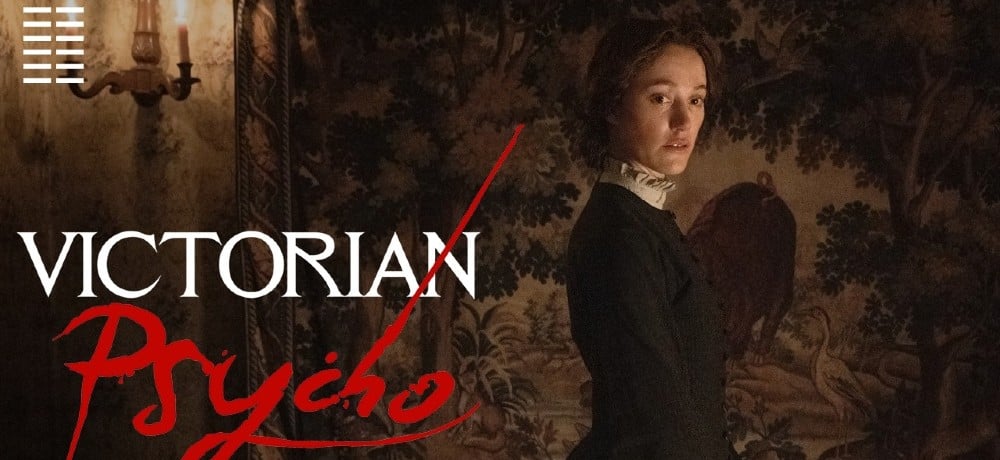
As Maika Monroe solidifies her legacy as a modern genre queen, Victorian Psycho shoots to the top of her resume. Zachary Wigon’s unruly period horror flick features the actress at her most unhinged—a blood-splattered treat. Virginia Feito pens a satirical examination of gender dynamics in 1850s British high society, where boys were considered heirs while daughters were boxed into household femininity. It’s a throat-slashing riot, and Wigon understands how to accentuate the societal horrors that would drive anyone mad. Monroe’s not an antique Patrick Bateman; Victorian Psycho is a thorn-studded stake to the heart of patriarchal classism.
Monroe stars as the mousy and offbeat Winifred Notty, Ensor House’s newest governess. Winifred dubs herself the sanest person she knows, moments after the camera spins from a crooked perspective to a straight-on, more normal frame. She’s welcomed by Mrs. Pounds (Ruth Wilson) and introduced to children Andrew (Jacobi Jupe) and Drusilla (Evie Templeton): Winifred’s new responsibilities. Mr. Pounds (Jason Isaacs) lords over the manor, insisting he give Winifred a private psychology reading. “I shall be worthy of this family,” she repeats like a mantra—but it might be the Pounds who deserve Winifred, in the end.
From the first shot—the brilliant, tilted peek into instability—Monroe is a fantastic maniac. It doesn’t take long before her teachings to the Pounds’ children go off the rails, or her violent, psychosexual tendencies bleed into everyday interactions. Her relationship with Thomasin McKenzie, as on-site nurse Ms. Lamb, goes from sisterly to borderline sweet to dangerously obsessed with such a delicious speed. There’s little downplaying of Winifred’s short fuse, and the impending explosion of rage that will befall the Pounds’ compound. The trick is justifying her outburst, which Wigon accomplishes.
Each prod by the Pounds clan drives Winifred closer to the brink. Wilson’s early detections of questionable antics in her governess make Mrs. Pounds an early adversary, which the motherly actress hilariously leans into. Isaacs is your boisterous and misogynistic blowhard type, owning his character’s skeevy advances. Then there’s the hilarity of Monroe scaring the jeepers out of Jupe’s groomed lil’ papa’s and mama’s boy, while Templeton’s brushed-aside daughter starts to display concerning, mirroring behaviors to Winifred. Beat by beat, these attacks chip away at Winifred’s fracturing psyche—the film’s entertainment.
However, Victorian Psycho doesn’t push the concept to extremes. Feito’s escalation of aggression has a polished first-draft feel; it’s an entertaining delve into socially bred disorder that exists as advertised. Nico Aguilar’s cinematography captures the royal accents of Ensor’s lavish estate while drawing out Winifred’s instabilities through devious camera movements, so it all looks accomplished. And the actors sell their roles as stated, with Wigon in full control of the tonal see-saw that Winifred controls. It’s more the routineness of Winifred’s fury, and its easy-to-follow blueprint.
But that doesn’t mean Victorian Psycho is a bust. Monroe flexes mischievous, murderous muscles as she awakens the beast inside her: Fred. Imagery of wild boars and heretic backgrounds instill a sense of demonic possession, represented by the vibrating thread-like light that wiggles wilder with each of the Prouds’ transgressions. Wigon lets life-ending gore speak for itself, and allows Monroe to steal the show. It’s exactly what the experience needs, selling the material for its gross examination of the gender disparity present between piggish men and the objectified, stay-in-their-lane women in their lives.
Victorian Psycho is a fresh take on age-old horrors that stays in line with expectations for the better. Monroe is a governess seeking safety and compassion, yet finds the cruel backhand of pompous, predatory, and entitled men of her time. Her sanity is always in question, driven by those who diagnose her. It’s a cheeky, carnage-chunky, oppressively charged take on women stealing back the power, albeit in a fixated period setting. It’s not like lessons have passed their expiration date. It’s an evergreen dark comedy that spills its share of blood.
Movie Score: 3.5/5